
Fat is crafted by processing Bio Waste in a Food Processor. Here’s the rigid sequence I follow:
- Farm Bio Waste from any Point of Interest (POI) or by killing underwater creatures at night.
- Reach level 10 to unlock the SoilForge recipe.
- Build the SoilForge and connect it to power plus Fresh Water.
- Place Bio Waste into the Food Processor (powered, with Fresh Water supplied).
- Wait for processing, then collect the Fat that drops on the ground behind the machine.
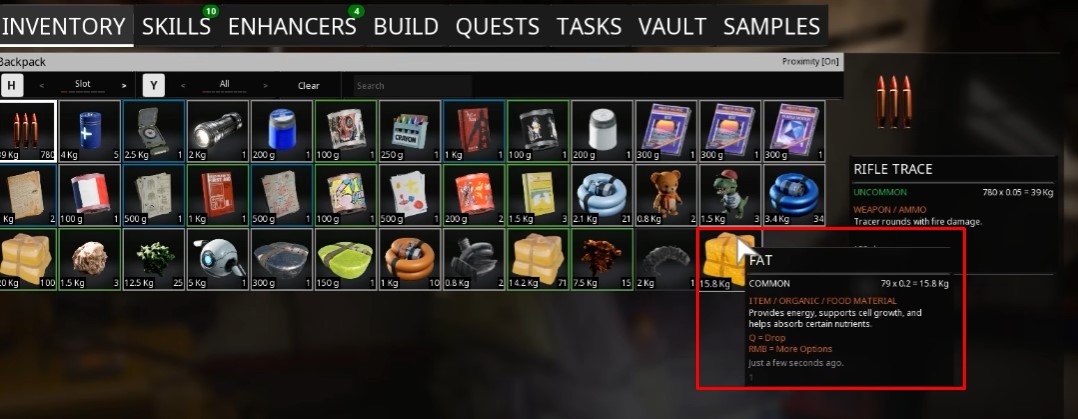
A single full run in my testing yielded 79 units of Fat.
Why Fat Matters and What This Route Covers
Fat is not a flashy endgame material, but it sits at the center of your mid-game crafting economy. The Food Processor consumes it as a base ingredient for other items, which means a shortage of Fat stalls your entire production chain.
The full loop breaks down into three distinct phases: farming the raw Bio Waste, unlocking the SoilForge at level 10, and running the Food Processor correctly. I will walk through each phase with the exact requirements so you do not waste time setting up a machine that cannot operate.
Step 1: Farming Bio Waste Without Wasting Time
Bio Waste is the only raw material you need for Fat production. I use two farming methods depending on the time of day, and they are not equal in efficiency.
Method 1: Point of Interest (POI) Looting
Search any POI around the game world. This is the passive approach — you grab Bio Waste while completing other objectives or exploring new areas. It works, but it is not something I rely on for bulk farming.
Method 2: Nighttime Underwater Farming
Wait until nightfall, then enter the water. Creatures spawn underwater during the night cycle, and defeating them grants a chance to drop Bio Waste.
This is my primary farming method because it is repeatable and does not depend on POI respawn timers. I equip my best weapon, head to the nearest deep water at night, and clear spawns until I have a comfortable stockpile.
Note: The nighttime water spawns are also your source for Bioorganic, which feeds into the Omega 3 production route. If you are farming one, you are effectively farming both.
Step 2: Unlocking the SoilForge at Level 10
You cannot craft Fat without the SoilForge, and the recipe does not become available until you hit level 10.
The SoilForge has its own operational requirements once built:
- It needs power connected.
- It must be filled with Fresh Water.
Fresh Water is not free — you need a Water Purifier machine to produce it. I set up the Water Purifier first, then build the SoilForge, so I am not stuck waiting for water production after the forge is already placed.
Tip: If you are also working on Calcium production, that route runs through the SoilForge as well. Unlocking it once covers multiple material chains.
Step 3: Setting Up the Food Processor Correctly
Fat is crafted inside the Food Processor, not the SoilForge. This is a common point of confusion, so let me be direct: the SoilForge unlocks the ability, but the Food Processor does the actual Fat crafting.
Before you place any Bio Waste into the machine, verify these two conditions:
| Requirement | How to Meet It |
|---|---|
| Power | Connect the Food Processor to your power grid |
| Fresh Water | Supply via a dedicated water production machine |
I check both connections first every single time. A Food Processor without Fresh Water will sit idle and waste your time.
Step 4: Crafting Fat — The Exact Sequence
Once the Food Processor is powered and has Fresh Water flowing, the crafting process is straightforward:
- Place Bio Waste into the Food Processor.
- Wait for the machine to process the waste.
- Locate the output — the crafted Fat drops on the ground behind the Food Processor.
- Collect the Fat from the ground before starting another batch.
The output appearing on the ground rather than in your inventory is the detail that trips most players up. I missed my first batch because I was staring at the machine’s front panel while the Fat sat behind it.
Warning: Do not queue multiple batches without collecting the previous output. Ground items can accumulate and become harder to track, especially if you are running multiple machines.
Result: What You Get and What It Is For
A single full processing run in my demonstration produced 79 units of Fat. That volume makes the route worth the setup effort — one solid farming session feeds multiple crafting projects afterward.
Fat is a required ingredient for crafting other items inside the Food Processor. It is not a material you stockpile for its own sake; it is the gateway to the next tier of your production chain.
If you are following the broader material production loop, the Omega 3 route uses the same infrastructure with Bioorganic as the input instead of Bio Waste. The systems overlap heavily, so mastering one makes the other significantly easier.
Compare: Bio Waste → Food Processor → Fat is the “waste-to-base” chain. Bioorganic → SoilForge → Omega 3 is the “organic-to-supplement” chain. Both require power and Fresh Water, but they use different processing machines.


